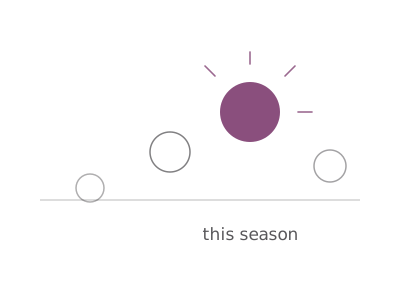
There's a kind of advice that sounds wise and is mostly useless: live a balanced life. As if balance were a steady state you could simply decide to occupy, holding every part of your life in equal tension week after week.
Real life doesn't work that way. It rotates. Someone launching a business has a stretch of weeks where fitness coasts and sleep suffers. Someone training for a race has a cycle where the social calendar thins. Someone with a newborn has a season where nearly everything else is on hold. These aren't failures of balance. Often they're the right call — a deliberate concentration of energy where it's needed most.
The trouble is that most ways of tracking goals can't tell this apart from quitting. "Skipped the gym for six weeks" looks identical whether you were strategically focused on a launch or simply drifting. So the system either nags through a period when nagging is exactly wrong, or, once silenced, loses the thread entirely. The resolution is to treat intentional imbalance as its own legitimate thing — and to make it explicit.
Declared, with an end date
What separates strategy from drift is almost entirely whether it was declared. A deliberate period of imbalance is one named in advance: what takes priority, what drops to maintenance, and — the part that does the real work — when it ends.
The end date is the mechanism. A period of imbalance with no defined end isn't a strategy; it's permanent imbalance wearing a justification. "I'll get back to it after this busy stretch," with no actual "after," is how an entire area of life disappears for a year. Committing to an end date converts a vague drift into a bounded, intentional choice — and the end matters as much as the start, because the moment to ask whether you're genuinely winding down or just extending by inertia is the moment it was supposed to be over.
Within such a period, pressure shouldn't vanish so much as rebalance. The de-prioritized areas drop to a floor rather than disappearing — you're still a person with a body during a launch — while the priority areas may warrant more attention than usual. The aim isn't to switch accountability off; it's to hold yourself to the terms you actually chose.
Why declaring it works
This counters two well-documented reasons goals fail.
The first is cognitive overload. Trying to advance everything at once yields meaningful progress on nothing, because attention is finite and treating every area as equally urgent crowds out what matters most. Consciously choosing what to let coast isn't neglect — it's the precondition for real focus. A declared season is that choice, made explicitly rather than by default.
The second is our poor grasp of our own future. The planning fallacy that Kahneman and Tversky identified in 1979 shows we systematically underestimate what things will take and overestimate what we can fit in, even when experience says otherwise. A bounded period with realistic scope and a hard end date is a structural defense: it assumes constraint rather than pretending it away, and the end date keeps an optimistic "I can do it all" from hardening into permanent overcommitment.
Deliberate versus drift: the only question that matters
Underneath all of this is a single distinction worth more than almost any other in thinking about balance: is this imbalance deliberate, or is it drift?
Deliberate imbalance is a strategy — declared, bounded, in service of something you value. Drift is the same surface behavior with no decision behind it: an area eroding because urgent things kept winning, not because you ever chose to let it go. From the outside, the two are indistinguishable. The only thing separating them is whether you declared it.
Which is why the declaration is the whole point. It's how you tell yourself, in advance and on the record, I am choosing this, and here is when it ends. And whatever isn't declared, a periodic step back is meant to catch — by asking the question the daily grind never does: is anything starving here, and did I mean for it to?
Balance was never about holding everything equal all the time. It's about making sure that when you tilt hard toward one thing, you did it on purpose — and that you remember to tilt back.
Next in the arc · 07
The silence: why the best tools stay out of your way →
Takes 15 minutes · no credit card