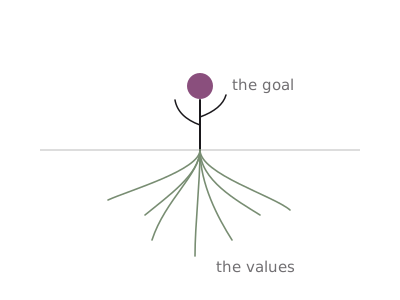
Most goal-setting starts in the wrong place. It starts with the goal.
"Run a marathon." "Hit a revenue number." "Read fifty books." These get written down, pursued for a few weeks, and quietly dropped — not because they were bad goals, but because they were never connected to anything underneath them. A goal floating free of a reason is the easiest thing in the world to abandon: the moment it gets hard, nothing holds it in place.
The fix isn't more discipline. It's getting the order right — building from roots upward rather than from the goal down.
Values are the roots
Underneath any goal worth keeping is a value — not another goal, but a statement of what matters and why. "Health and longevity." "Being a present parent." "Mastery of my craft." Values are few, slow to change, and close to bedrock. Goals should draw their legitimacy from them, never the reverse.
The motivation research explains why this ordering matters so much. Self-Determination Theory, developed by Edward Deci and Richard Ryan, distinguishes autonomous motivation — acting because the behavior aligns with your own values — from controlled motivation, acting out of pressure or guilt. Replicated across many domains, their core finding is that autonomous motivation produces durable behavior, while controlled motivation collapses once the external pressure is gone. A goal rooted in a value draws on the first kind. A goal rooted in nothing but obligation draws on the second, and fades accordingly.
There's a useful corollary. If you can't trace a goal back to anything you genuinely care about, that's not a motivation problem to push through — it's a signal the goal may not belong in your life at all.
The shape of a whole life
Above individual goals sits a question they can't answer on their own: is your life, taken as a whole, the shape you want?
Goal-by-goal thinking has a blind spot. You can be technically on track on every goal you've set while an entire area of your life — one you never made a goal of — quietly decays. Relationships are the classic casualty; almost nobody writes "don't drift from my closest friends" as a measurable objective, so it slips off the map and erodes unnoticed. Thinking in terms of life areas — health, relationships, work, learning, finances, and the rest — is what surfaces the part of life that's starving precisely because no goal was ever pointed at it.
Goals, made specific
Now — and only now — the goal itself. Here specificity genuinely matters: Locke and Latham's decades of research show specific, challenging goals consistently outperform vague ones. A goal vague enough to escape definition is also vague enough to escape achievement.
But specificity carries a documented risk when it floats free of meaning: a target pursued purely for its own sake invites gaming and hollow wins. This is exactly why the value comes first. A specific goal in service of something you care about is powerful; a specific goal in service of nothing is just a number you'll eventually learn to game or quietly drop.
Behaviors do the work
At the base, the part that actually runs: the daily and weekly behaviors that turn a goal into reality. This is where goals are won or lost, and the evidence is clear that outcomes follow from process, not intentions — but that's a large enough subject to be its own post, which is where it goes next.
Why the direction is the point
Built from the roots up, every layer is legitimate: the behaviors serve a goal, the goal serves an area of life you care about, that area expresses a value. When a Tuesday run gets hard, the chain holds all the way up to why you're a person who runs.
Built from the goal down — goal first, reason later — you get the familiar pile of abandoned resolutions. The behavior had nothing holding it up. Most goal-setting fails not because the goals were wrong, but because they were built in the wrong direction.
Next in the arc · 04
The loop: turning intention into reliable action →
Takes 15 minutes · no credit card