Here is the uncomfortable truth about follow-through: it is almost never a question of how badly you want something. People who fail to follow through usually want the outcome just as much as people who succeed. The difference isn't desire. It's structure.
We tend to imagine follow-through as a single act of will, repeated daily — you decide to do the thing, and either you're disciplined enough to do it or you're not. That model is both wrong and quietly cruel, because it turns every missed day into evidence of a character defect. The research points somewhere more useful: consistent action is the output of a loop, and when the loop is built well, far less willpower is required. When any piece of it is missing, no amount of willpower compensates for long.
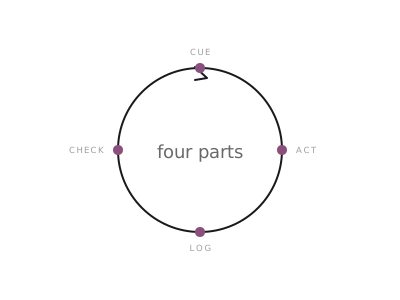
The loop has four parts. They reinforce each other, which is why they have to be understood together rather than one at a time.
1. A plan small enough to be real
Most plans fail before they begin because they're scoped for an imaginary version of you. We systematically underestimate how long things take and overestimate what we'll have the energy for — the planning fallacy that Kahneman and Tversky identified in 1979, where even people with direct experience of a task running long still expect this time to be different.
The countermeasure is to plan for the ordinary, tired, busy version of yourself, and to make the unit of action small. Not "train for a marathon" but "three runs a week." Not "write the book" but "500 words before breakfast." A plan you can execute on an average Tuesday — not just an inspired Sunday — is the only kind that survives contact with real life. Ambition belongs in the goal; realism belongs in the plan.
2. A cue that removes the decision
Even a small plan fails if it depends on remembering to act, and on wanting to in the moment. Both are unreliable. The most effective fix in the entire behavior-change literature is almost embarrassingly simple: decide the when and where in advance.
These are called implementation intentions — "if it's 7am and I've made coffee, then I put on my running shoes" — and they work by pre-loading the decision so the moment itself requires no deliberation. Peter Gollwitzer and Paschal Sheeran's meta-analysis across 94 studies found a medium-to-large effect (d = .65) on goal attainment from this one technique. Attaching a new behavior to an existing cue, and arranging your environment so the behavior is the path of least resistance, does more for consistency than any amount of resolve. The aim is to need as little willpower as possible, not as much.
3. A feedback loop that catches drift early
A plan and a cue get you started. Staying on track requires seeing whether you're on track — and this is where most private, in-your-head goals quietly die. Without a signal, slippage is invisible until it's a full stop, by which point the habit is gone and so is the momentum.
Monitoring is not bureaucracy; it's the sensor that makes everything else adjustable. A meta-analysis by Benjamin Harkin and colleagues found that prompting people to track progress toward a goal reliably increased attainment, and that the effect was stronger when progress was physically recorded or made visible. The point of seeing the data isn't to grade yourself. It's to notice the drift while it's still small enough to correct.
4. Follow-up that responds, not punishes
The final piece is what happens when the feedback loop shows a miss — and it's the piece that determines whether the whole loop survives a bad week. The instinct, especially in tools built like taskmasters, is to treat a miss as a failure to be penalized. That backfires. Harsh self-criticism after a slip tends to produce disengagement; in four experiments, Juliana Breines and Serena Chen found that responding to a setback with self-compassion increased the motivation to improve, relative to self-criticism.
Good follow-up is proportionate. A single miss is noise — it warrants a neutral note, not an alarm. A genuine pattern warrants a real question: is the plan wrong, is the cue not firing, has the goal lost its meaning? Follow-up that treats a missed day as information feeds the next turn of the loop. Follow-up that treats it as a verdict ends the loop entirely — which is precisely how the "one slip and I quit" collapse happens.
Why it has to be a loop
Pull the pieces apart and each is fragile. A small plan with no cue depends on memory and mood. A cue with no feedback loop drifts unnoticed. A feedback loop with punishing follow-up triggers the collapse it was meant to prevent. An ambitious plan with none of the rest is just a wish.
Together, they compound. The realistic plan makes the cue easy to honor. The cue generates the actions the feedback loop can see. The feedback loop surfaces drift early enough that follow-up can be gentle and corrective rather than dramatic. And proportionate follow-up keeps you in the loop long enough to adjust the plan — which makes the next cycle a little more realistic than the last.
This is why follow-through is better understood as a system than a virtue. The people who seem to have endless discipline usually don't. They have a loop that asks less of their discipline, and recovers quickly when it slips. That's a thing you can build, and it's a far more reliable foundation than hoping to want it badly enough.
Next in the arc · 05
The slip: recovering from the missed day →
Takes 15 minutes · no credit card