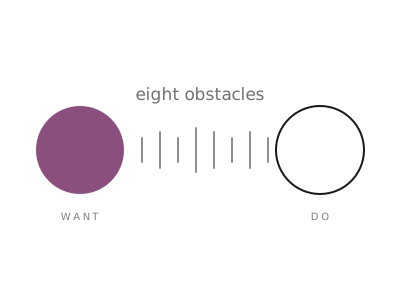
Most advice about goals concerns how to set them. But people rarely fail at setting goals. They fail in the long gap between the goal and the life it was supposed to produce — and that gap is where the real obstacles live.
The encouraging part is that these obstacles are well studied. None is a character flaw. They're predictable features of how human attention, emotion, and motivation work, which means they can be understood and, with the right structure, worked around. Here are eight of the most consequential. The next several posts take the most important of them apart in detail; this is the map.
1. The clarity trap: inspiration isn't a plan
"Get in shape." "Be more present." "Grow the business." These feel like goals, but they're closer to moods. There's nothing to do tomorrow morning and no way to know whether you did it.
The research here is among the most replicated in psychology. Across more than three decades of studies, Edwin Locke and Gary Latham found that specific, challenging goals reliably produce higher performance than vague "do your best" goals. Vagueness isn't motivating; it's an escape hatch, because a goal with no definition can never be definitively failed — or achieved.
2. Cognitive overload: too many goals, no priorities
Set fifteen goals and you've effectively set zero. Attention is finite, and a list that treats every ambition as equally urgent guarantees the important ones get crowded out by the merely loud ones. The harder discipline than choosing what to pursue is choosing what not to — letting some things coast so others can get real focus.
3. Misjudging your future time and energy
We plan as if next month's version of us will be rested, motivated, and free. They won't be; they'll be about as stretched as we are now. This is the planning fallacy, identified by Daniel Kahneman and Amos Tversky in 1979: a systematic tendency to underestimate how long things will take, even with direct experience of similar tasks running long. In one well-known study, students estimated their thesis would take around 34 days; many took considerably longer than their own optimistic guess. The defensible response is to plan for the ordinary, constrained version of yourself, not the idealized one.
4. The what-the-hell effect: one slip becomes total collapse
You miss one day, think well, I've blown it now, and abandon the whole effort. The skipped session wasn't the problem; the story you told yourself about it was. Janet Polivy and C. Peter Herman named this the "what-the-hell effect": the perception of having broken a goal triggers a cascade of the very behavior you were trying to control. It's strongest for goals framed as short-term and all-or-nothing — which is exactly why treating partial effort as total failure is so destructive.
5. No feedback loop: you can't manage what you can't see
Goals pursued purely in your head drift, because there's no signal when they begin slipping. Monitoring matters more than people expect: a meta-analysis by Benjamin Harkin and colleagues found that prompting people to track progress toward a goal reliably increased the likelihood of reaching it, with the effect stronger when progress was physically recorded or made visible. The feedback loop is what makes adjustment possible.
6. Lack of visibility: goals buried under daily fires
Your goals concern the life you want over years; your days are about the email that just arrived. Urgent reliably beats important, and over months the important things vanish under operational noise — not by decision, just by neglect. Catching this takes a deliberate step back to ask life-shaped questions rather than task-shaped ones: which areas have I fed, which have I starved, and has anything quietly fallen out of my life entirely?
7. Friction and inertia: starting is the hardest part
A new behavior asks you to act against the path of least resistance every time, until it stops being new. Relying on motivation to clear that bar daily is a losing bet, since motivation is the thing that fluctuates. The most effective planning technique in the literature, the implementation intention — pre-deciding the when and where in simple "if-then" form — works by removing the in-the-moment decision entirely. A meta-analysis by Peter Gollwitzer and Paschal Sheeran across 94 studies found it had a medium-to-large effect (d = .65) on goal attainment.
8. Hyperbolic discounting: now always beats later
The brain heavily overvalues immediate rewards relative to future ones — the couch now over the run that pays off months from now. This isn't weakness; it's a stable, well-documented feature of how people discount the future, and the curve is steep enough that the long-term good routinely loses to the short-term easy. What pushes back is keeping the long-term why vivid at the moment of choice, and shrinking the distant goal into a behavior small enough to win today.
The common thread
None of these eight is a moral failing. They're standard equipment of the human mind, present in everyone. Approaches that ignore them — relying on enthusiasm, guilt, or willpower — fail for the same reason each time. Approaches that work start by taking the obstacles seriously and building structure around the person you actually are on an average Tuesday, not the idealized one who set the goal. The rest follows from there.
Next in the arc · 03
Roots: why goals need values underneath them →
Takes 15 minutes · no credit card