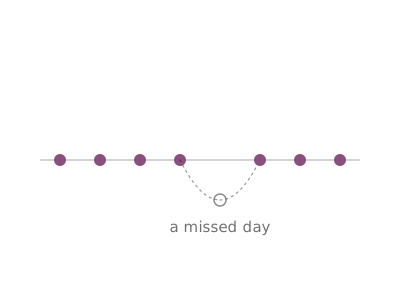
Every effort to change a behavior eventually meets the same moment: the missed day. You skip the workout, break the diet, lose the writing streak. What happens next matters far more than the slip itself — and it's where most attempts quietly end.
The danger isn't the missed day. It's the story the missed day tends to trigger.
The what-the-hell effect
Janet Polivy and C. Peter Herman documented the pattern in dieting research and gave it a memorable name: the "what-the-hell effect." The perception of having broken a goal sets off a cascade of the very behavior you were trying to control. One cookie off the plan becomes the whole box — not because of the cookie, but because of the thought that follows it: I've already blown it, so what the hell.
Two findings from this research matter for anyone trying to stay consistent. First, the effect is strongest for goals framed as short-term and all-or-nothing. Second, it can be defused — longer-term goals, and goals framed around building something rather than merely abstaining, are far more resistant to the collapse. The structure of the goal shapes how survivable a slip is.
This is the hidden flaw in the streak, the chain of unbroken days that so many tools are built around. A streak's entire motivational force comes from being unbroken, so the day you miss, it doesn't just stop helping — it inverts. The long chain becomes a zero, and the zero says you failed. A streak is, almost by design, the structure most likely to turn a single slip into total abandonment, because it's the purest possible all-or-nothing frame.
Partial credit is not a consolation prize
The first defense against the spiral is to stop treating partial effort as failure. Two of three planned runs is not the same as zero. Five hundred words instead of a thousand is not the same as a blank page. A system — or a self-talk habit — that files "did most of it" under the same heading as "did nothing" is manufacturing the exact all-or-nothing framing that triggers the collapse.
Honoring partial effort isn't lowering the bar. It's refusing to let a good-enough day be reframed as a failed one, because that reframe is what ends the whole endeavor.
Recovery beats perfection
The second defense is to design for recovery rather than for an unbroken record. What protects long-term change isn't never slipping; it's slipping and returning quickly. A method built around recovery treats a miss as a single data point and asks the useful question — what got in the way, and does anything need to change — rather than rendering a verdict.
This is also why responding to a slip with harsh self-judgment is counterproductive, however natural it feels. The research runs against the intuition: in four experiments, Juliana Breines and Serena Chen found that treating yourself with compassion after a setback increased motivation to improve, compared with self-criticism. Kristin Neff's broader work converges on the same conclusion — self-compassion supports a learning orientation, while self-criticism drives avoidance. Being kind to yourself after a miss isn't indulgence. It's the response most likely to get you moving again.
What a good response to a slip looks like
Put together, recovering from a missed day looks less like punishment and more like a brief, honest check. The slip is acknowledged plainly — not ignored, since pretending not to notice is its own kind of disrespect, but not catastrophized either. Partial progress is counted as progress. A single miss passes as noise. And if a real pattern is forming, that's worth a genuine look at whether the plan, the cue, or the goal itself needs to change.
The missed day is inevitable. Treated as a verdict, it ends things. Treated as information, it's just one ordinary point on a long line — which is exactly what it is.
Next in the arc · 06
The season: when focus means letting things slide →
Takes 15 minutes · no credit card