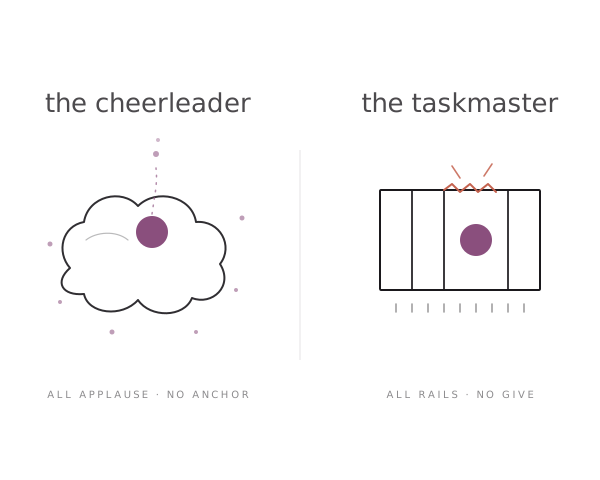
Most attempts to change your own behavior fail in one of two predictable ways. Before any method is worth discussing, it's worth seeing both clearly — because nearly everything that doesn't work is some version of one or the other.
The cheerleader
The first is the cheerleader. It celebrates every win, offers encouragement, and goes quiet when you stop showing up. Its instinct is to make you feel good in the moment — which feels like support, and occasionally is, but more often it's avoidance wearing the costume of kindness.
The cheerleader never asks the uncomfortable question, because the uncomfortable question risks the good feeling. It affirms without challenging. And when affirmation is the only move available, accountability quietly disappears: there's no version of the cheerleader that says you've skipped this three weeks running — what's actually going on? So the behavior it was meant to support erodes, gently and without comment.
This is the failure mode of most consumer wellness products, and it isn't an accident. Anything measured by how good it makes you feel, or how often you come back, is structurally biased toward telling you what you want to hear.
The taskmaster
The opposite failure is the taskmaster. It hands you a rigid plan, a wall of checkboxes, and a reprimand when you miss. It treats every deviation as non-compliance and every slip as a moral failing.
The taskmaster mistakes rigidity for rigor. It has no model for a sick week, a family emergency, a real change of circumstance, or a deliberate decision to focus elsewhere for a while. Because it can't tell life is genuinely hard right now apart from I've gotten lazy, it applies the same pressure to both — cruel exactly when it should be gentle. People abandon it the moment life stops fitting the spreadsheet.
There's a deeper problem underneath. Decades of motivation research distinguish between autonomous motivation — acting because the behavior aligns with what you value — and controlled motivation, acting out of external pressure or guilt. In the work of Edward Deci and Richard Ryan, autonomous motivation produces behavior that lasts, while controlled motivation collapses the moment the pressure lifts. The taskmaster runs entirely on the second kind. That's why its results evaporate the day you stop being watched.
What it takes to fail neither way
The two failures, side by side, reveal what's actually required: a firm spine and a soft opening, held together at once.
A firm spine is real accountability — noticing when you drift, responding in proportion to the pattern rather than letting it pass in silence, and not allowing a goal to be abandoned without at least an honest conversation about why.
A soft opening is entering with curiosity rather than commands: asking before telling, treating you as the expert on your own life, and knowing when circumstances genuinely call for easing off — without mistaking ordinary discomfort for a real crisis.
Holding both is hard, which is why so little manages it. A cheerleader is easy to build: remove the friction. So is a taskmaster: add rules. The combination demands an actual method — a way of deciding when to push and when to soften, how accountability should escalate, and what makes a goal worth holding someone to in the first place. The posts that follow take those questions one at a time, roughly in the order a goal travels: from the values underneath it, through the daily work of following through, to the slips and seasons that real life guarantees.
Next in the arc · 02
The gap between wanting and doing →
Takes 15 minutes · no credit card